
No products in the cart.
Q: What do Mongolian prisoners, seven-year-old children and our competitors have in common?
A: They are not our customers!
I asked a distributor to describe his ideal customer. Why?
Because we want to know how our customer thinks. We want to sell what our customer wants. We want to bond with our customer. And we can’t do this unless we know who our customer is.
Here is our conversation:
Big Al: Who are your customers?
Distributor: Everyone!
Big Al: Everyone?
Distributor: Yes, everybody is a customer for my wonderful products.
Big Al: Well, what about prisoners in Mongolia? Are they customers for your wonderful products?
Distributor: Well, no, of course not. They live in a foreign country and we haven’t expanded there yet. Plus, they won’t have any extra income as a prisoner in Mongolia. And they don’t speak English. Gee, they couldn’t even read our classy brochure. So no, I don’t think Mongolian prisoners are customers for my wonderful products.
Big Al: So what you are saying is that everybody is a customer for your wonderful products except for Mongolian prisoners, right?
Distributor: Yes. Everybody else is a customer.
Big Al: What about somebody who is only seven years old? Is that person a customer for your wonderful products?
Distributor: Uh, no, of course not, because that person is only seven years old. They wouldn’t understand our wonderful products. Plus, they wouldn’t have any money unless they asked their parents.
Big Al: So, what you are saying is that everybody is a customer for your wonderful products except Mongolian prisoners and people who are seven years old, right?
Distributor: Right. Everybody else is a customer.
Big Al: Well, out of curiosity, what about competitors who don’t like your wonderful products? They want to criticize your wonderful products so that their products look better.
Distributor: Well, of course not. They want to push their inferior products to the public. So of course they are not customers for my wonderful products.
Big Al: Let me understand. What you are saying is that everybody is a customer for your wonderful products except for Mongolian prisoners, people who are seven years old, and competitors who sell inferior products. Is that right?
Distributor: Uh, right.
Big Al: Well, what about ...
And so the conversation continues. After mentioning several more categories of people, the distributor finally says:
“You’re right. I guess not everybody is a customer for my wonderful products. Only some people are good customers for my wonderful products. I need to identify that group.”
So how about our wonderful products? If we don’t know who our customers are, how can we effectively market our wonderful products to them?
How can we know what our customers want if we don’t know who our customers are?
Targeting a small group of highly-qualified candidates will make retailing easier. These people will want to become customers because they want what we have to offer.
Let’s take a look at a few examples.
Ashley markets air filters.
This is easy. Let’s make a list of prospects for her products.
- People with asthma.
- People who have allergies and hay fever.
- People who can’t sleep at night because of their allergies.
- People who work with smokers.
- People with pets.
- People who cook with onions and garlic.
- People who live next to a busy highway.
- People who live in cities with smog.
- People who work with sick people who sneeze and cough.
This is pretty easy. With a little creative thinking we can come up with more, but let’s look at another example of marketing to a niche of highly-qualified potential customers.
Dan sells energy products.
This is too easy. Let’s make a list of people who would want what he sells.
- Computer programmers who sit all day.
- Taxi drivers.
- People working the night shift.
- Office workers with boring jobs.
- Truck drivers.
- Parents with full-time jobs.
- Joggers.
- People who work out at health clubs.
- College students.
As you can see, it is so much easier to talk to these people. They have a big problem that we can solve.
Heather sells diet products.
Overweight people are easy to spot. Again, it is obvious that not everyone wants what Heather sells. So where should we find these overweight people?
- Donut shops.
- Large and tall men’s stores.
- By the candy bar vending machines.
- Health clubs, where they are walking ever so slowly on the treadmills.
- All-you-can-eat buffets.
- Stationary people on moving walkways.
But wait, what about other people who want to lose weight? These are motivated buyers. Let’s make a list.
- Brides-to-be.
- Mothers of brides-to-be. (Yes, they will be in the pictures.)
- Thin people who work out and want to stay thin.
- Fashion-conscious people who always want to look good.
Brides-to-be? Mothers of brides-to-be? Can they be hot prospects?
Yes! In our book, 51 Ways and Places to Sponsor New Distributors: Discover Hot Prospects For Your Network Marketing Business, we tell a story about selling to brides-to-be.
While eating Mexican food with distributors from a workshop, I asked the lady across the table what she sold. She answered, “I sell diet products.”
To continue the conversation, I asked, “So how is it going?”
She told me, “I am so tired. Every day I am delivering boxes and boxes of my diet products to customers all over the city. This is exhausting.”
Now, I am thinking, “That is pretty incredible. She must have a secret. Maybe the diet products are a bargain or something.” So I asked her, “Well, how much do these diet products cost?”
She said, “Well, the cheapest package is $350 for a month supply, but I normally sell the $600 packs.”
I now think, “$600 a pack? I could buy 300 baskets of these tortilla chips for that. That is expensive for a month of diet products. How could she sell that many packs so easily?” But, I kept my composure and posture. I then asked, “So tell me. Where do you find these prospects for those expensive $600 diet packs? Let me know and maybe I could give you some advice or a tip or two.”
Her reply sums up why it is important to know who our prospects are. She said:
“I go to bridal shows and talk to the brides-to-be. When I ask them if they want to lose a little weight before the wedding, they instantly say, ‘Yes.’ This is the big day in their life. No matter how anorexic-looking the bride-to-be is, every bride wants to lose a little more weight before their special moment.
“The average wedding costs between $20,000 and $50,000 here. The $600 diet pack isn’t even a thought, it is barely a tip. So the bride-to-be orders immediately, no questions asked.
“But then the mother of the bride thinks that she wants to lose weight too. She doesn’t want to look fat in those wedding pictures for the rest of eternity. She orders her pack.
“And so does the future mother-in-law. She doesn’t want to be the fat one in the picture.
“And ... the bridesmaids. They already are going to look awful in those off-colored dresses they have to wear to make the bride look pretty. They don’t want to look awful and fat. They order too.
“So I load up my car with as many packs as I can, and I spend the entire day delivering and talking to my new, enthusiastic customers.”
Needless to say, I didn’t give her any advice or tips. She was doing fine with her very targeted market.
Ed sells discounted electricity and gas.
So who are the people who want to save money?
- People who buy boring and efficient used cars.
- People who shop at discount warehouses.
- People who complain that their house taxes are too high.
- Young families with stretched budgets.
- People who shop with coupons. Elderly people on fixed budgets.
- People who would feel embarrassed that they were overpaying, while their neighbors got discounts.
Janet sells cosmetics and fragrances.
Well, let’s get a little creative here. Ready to look at a bigger picture?
Let’s find potential customers that will spend lots of money, no questions asked.
Janet approaches men. She terrorizes them with this simple question: “Do you like to go gift shopping?” The men freeze. Their thoughts turn to standing helplessly in a department store, knowing that whatever they buy will be wrong. Most men have a big problem with shopping for gifts. They hate it. They don’t know what to get. It will always be the wrong thing.
While the men are still stunned and unable to talk, Janet continues, “Would it be okay if I took care of it for you?”
Instant relief from the men’s faces. Mentally they think, “Here is all my money. Relieve me of this gift-shopping torture.”
Janet asks, “Who do you need to buy gifts for?”
The men might say, “Wife, girlfriend, co-worker, mom, daughter and more.” That is a lot of uncomfortable shopping.
But Janet has more questions. She asks, “And how many times a year do you have to buy these gifts?”
“Oh, Christmas, their birthdays, Valentine’s Day, Mother’s Day, and ... oh yes, our anniversary too. That seems to come around every year! Just tell me how much I should spend on each gift.”
Plenty of instant sales for Janet. No price objections ever. Janet doesn’t know any of the people receiving the gifts, but she can do a much better job of guessing because she knows her products and her market. She is solving a huge problem for the men.
It doesn’t stop here. Janet picks up some extra cash by asking, “Do you want me to get the present gift-wrapped?” The men think, “Yes! I don’t know how to wrap gifts. I would have to buy duct tape from the local hardware store, and where would I look for gift-wrapping paper? Any paper mills in town?” So for a few more dollars of profit, Janet solves their gift-wrapping problem.
Next Janet asks, “Do you want me to buy a card for your gift? I can show you where to sign the card.” The men think, “Card? I need a card? I better leave this in the hands of a professional. Janet can have all my money!”
But wait! There is more! Janet says, “And you should buy a gift card also, to make sure she can get anything we missed in the gift basket.” This means the gift recipient will be calling Janet to redeem her gift card. A chance for a personal conversation and more sales.
And finally, Janet says, “And I will deliver the gift basket to your office.”
Why does she deliver to the office? Because every other man in the office will see the delivery and ask for her gift-shopping services. What an easy way to get more retail customers who are big spenders.
The purpose of business is to solve problems.
Which problems does Janet solve?
First, she relieves men of a recurring stress in their lives, gift shopping.
Second, the gift recipients will be getting a gift basket they love, instead of ill-conceived gifts from men.
Janet finds new customers easily by asking men, “Do you like to go gift shopping?”
Not everyone is a prospect for what we sell. We don’t want to waste our time and efforts. Instead, we can target hot prospects who are ready for what we have to offer.
Can I target even hotter potential customers?
Yes. We do that by promoting our products to select individuals. Exclusive offers attract highly-qualified people who are eager to buy.
Think of it this way. Which offer appears better to a dieter?
Offer #1. Diet products that will help you lose weight.
Offer #2. Diet products for people who need to lose 20+ pounds.
The second offer sounds better. It sounds more attractive to people who have 20+ pounds to lose. They feel like the products are designed for people with a lot of weight to lose.
The bad news? Some people with less than 20 pounds to lose might not be interested.
The good news? People with 20+ pounds to lose will feel like our diet products are formulated just for them. Hardly any salesmanship needed.
Here are some examples of making our products more exclusive:
- Homeowners only. Special utility plans for people who own their own homes.
- Skincare for women over 55.
- Affordable legal services for small business owners only.
- Natural cleaners for people with sensitive skin and allergies.
- Coffee for people with sensitive stomachs.
- Water filters for people in the new Hometown Village.
- Antioxidants for senior citizens.
- Natural whitening toothpaste for coffee drinkers.
Our customers are everywhere. When we promote our products to a special group, qualified customers “raise their hands” and want to buy from us.
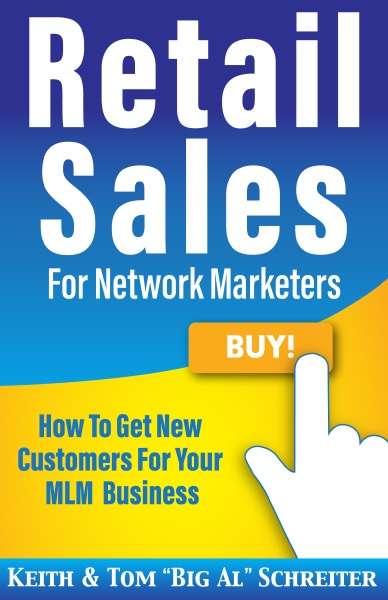
This is an excerpt from the book, “Retail Sales for Network Marketers.”
Available in paperback, ebook, and audio.